CE marked
Certified to European standards for safe operation in public, unstaffed environments.
The technology
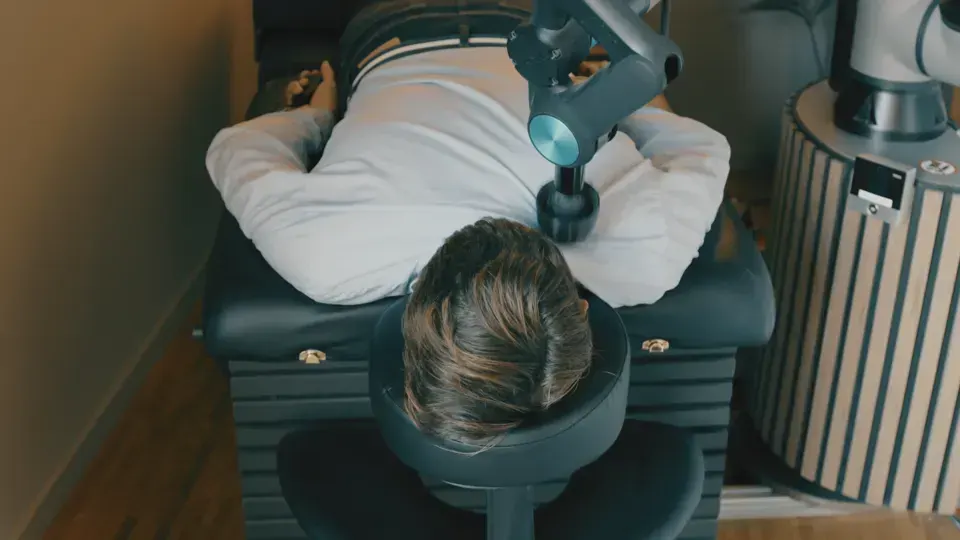
The Self AI Recovery Bed combines robotics, computer vision and machine learning to deliver autonomous, personalised recovery — the intelligence of a great therapist, in a robot that never has an off day.
What is Physical AI?
Most AI lives on a screen. Physical AI, the stack behind Self, reaches into the real world: it perceives a person in three dimensions, decides what their body needs, and moves with therapist-trained precision to deliver it, safely, and the same way every time.
That combination, perception, decision and safe motion, is what turns a robot arm into recovery infrastructure.
The stack
On-board cameras and sensors read the body in real time, posture, shape and response, adjusting pressure as the session unfolds.
A point-cloud scan builds a precise model of each person, so Self knows exactly where to work, and remembers for next time.
Techniques modelled on real therapists are planned by AI and tuned to the individual, session over session.
A CE-marked collaborative robot delivers the motion with force-limited, multi-layer safety, built for unsupervised public use.
It compounds
Self isn't static. Each visit feeds a profile unique to the individual, so the recovery fits a little better every time, and the intelligence behind it keeps improving across every unit on the network.
That's the long game: millions of sessions compounding into the operating system for recovery.
Read the body
Build the profile
Tune the session
Improve the network
Safety & certification
Certified to European standards for safe operation in public, unstaffed environments.
A collaborative robot designed to work safely alongside people, with motion that yields on contact.
Multiple independent safety systems and an always-available stop keep every session in the user's control.
The platform
The same intelligence that powers the recovery robot is a layer others can build on. "Powered by Self" licenses the stack beneath other brands and surfaces, with biometric sensing as the long-horizon upside.